Press release 24/07/2025
POPULATION AND HOUSING CENSUS – EMPLOYMENT. 01/01/2024
According to the data for January 2024, in the Basque Country those born abroad have a higher employment rate but also a higher unemployment rate
Half of all people in employment work in the same province where they have their home, albeit in a different municipality
As of 1 January 2024, individuals residing in the Basque Country but born outside of Spain have a higher employment rate than the region’s native residents, according to data prepared by Eustat. For its part, the unemployment rate is also higher for those born abroad, although there are significant differences depending on country of origin. The highest unemployment rate is among residents born in Africa (32.2%), followed by those born in Asia and Oceania (12.5%) and the rest of Europe (12.2%). Basque Country residents born in Spain have the lowest unemployment rate (6%), followed by those born in the Americas (8.6%).
In some instances, the difference between the genders is particularly acute, depending on place of birth. The most extreme case is that of women born in Africa, who have an unemployment rate of 52.3% compared to 21.5% for men from the same continent. There is also a significant gender gap for Asia and Oceania (20.0% of women compared to 7.7% of men).
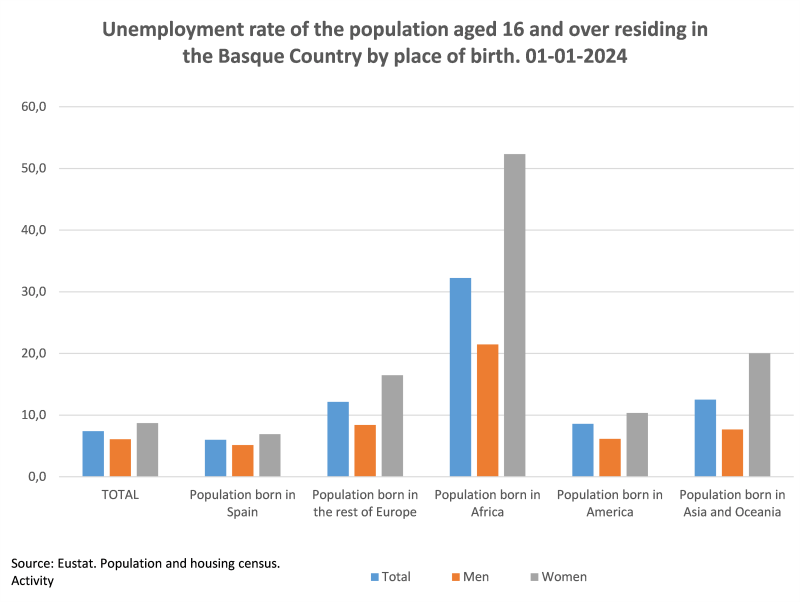
Between 2021 and 2024, the unemployment rate across all groups generally improved, regardless of country of origin. The biggest decrease in unemployment is among residents born in the Americas, whose rate has fallen from 16.5% in 2021 to 8.6% in 2024. Similarly, the unemployment rate has fallen for residents born in Spain (from 9.8% to 6.0%) as well as for those born elsewhere in Europe (from 17.68% to 12.15%). Residents born in Africa have the highest unemployment rate (32.3%), even though their rate fell by almost eight percentage points over the period of reference. Within this group, the gender gap remains the same as in 2021: while the male unemployment rate fell between 2021 and 2024, the female equivalent remained at 52.3% over the same period. The same phenomenon is observed for residents born in Asia and Oceania. However, for residents born in the Americas, the female unemployment rate has fallen by more than six percentage points, from 16.7% to 10.3%.
The highest employment rates are recorded for residents born in Europe (63.2%), Africa (62.8%) and the Americas (61%), all of whom boast higher rates than those born in Spain (55.6%).
The unemployment rate has improved across all of the Basque regions, with decreases ranging from 2.5% to 6% between 2021 and 2024
With regard to the evolution of the unemployment rate, and in geographical terms, the rate has fallen across the board and in the majority of the regions of the Basque Country. Rioja Alavesa and Markina-Ondarroa have recorded the greatest improvements since 2021, with decreases of 6.3% and 5.5%, respectively. The regions of Añana (-5%) and Bajo Bidasoa (-4.8%) have also improved markedly during this period. Other regions have recorded more modest improvements: in Bajo Deba and Montaña Alavesa, for example, the unemployment rate fell by 2.5% between 2021 and 2024.
Evolution of the unemployment rate of the population aged 16 and over residing in the Basque Country by districts (%). 2020-2024


| |
2020 |
2021 |
2022 |
2023 |
2024 |
Difference 2024-2023 |
Difference 2024-2021 |
| |
| Basque Country |
10.1 |
11.4 |
9.7 |
8.5 |
7.4 |
-1.1 |
-4 |
| |
| Districts |
|
|
|
|
|
|
|
| Añana |
9.5 |
11.2 |
8.7 |
7.8 |
6.2 |
-1.6 |
-5 |
| Arabako Errioxa / Rioja Alavesa |
11.9 |
13.5 |
10 |
9.6 |
7.2 |
-2.4 |
-6.3 |
| Arabako Kantaurialdea / Cantábrica Alavesa |
10.8 |
12 |
9.5 |
8.4 |
8 |
-0.4 |
-4 |
| Arabako Lautada / Llanada Alavesa |
10.5 |
12 |
10 |
9 |
7.9 |
-1.1 |
-4.1 |
| Arabako Mendialdea / Montaña Alavesa |
7 |
8.5 |
7 |
5.8 |
6 |
0.2 |
-2.5 |
| Arratia Nerbioi / Arratia-Nervión |
9.5 |
10.8 |
9.4 |
8.2 |
7.3 |
-0.9 |
-3.5 |
| Bidasoa Behea / Bajo Bidasoa |
10.7 |
11.8 |
10 |
8.8 |
7 |
-1.8 |
-4.8 |
| Bilbo Handia / Gran Bilbao |
11.6 |
12.9 |
11.5 |
9.9 |
8.8 |
-1.1 |
-4.1 |
| Debabarrena / Bajo Deba |
10.1 |
10.7 |
9.1 |
8.4 |
8.2 |
-0.2 |
-2.5 |
| Debagoiena / Alto Deba |
7.5 |
8.4 |
7 |
6.7 |
5.7 |
-1 |
-2.7 |
| Donostialdea / Donostia-San Sebastián |
8.2 |
9.5 |
7.8 |
7.1 |
5.6 |
-1.5 |
-3.9 |
| Durangaldea / Duranguesado |
9 |
10.1 |
8.4 |
6.9 |
5.7 |
-1.2 |
-4.4 |
| Enkartazioak / Encartaciones |
12.4 |
13.1 |
11.9 |
10.4 |
9.5 |
-0.9 |
-3.6 |
| Gernika-Bermeo |
11 |
11.6 |
9.6 |
8.2 |
6.9 |
-1.3 |
-4.7 |
| Goierri |
7.7 |
8.7 |
7.3 |
7 |
5.9 |
-1.1 |
-2.8 |
| Gorbeialdea / Estribaciones del Gorbea |
6.6 |
8.3 |
6.9 |
6.2 |
5 |
-1.2 |
-3.3 |
| Markina-Ondarroa |
9.9 |
11.1 |
8.2 |
7 |
5.6 |
-1.4 |
-5.5 |
| Plentzia-Mungia |
8.9 |
10.3 |
8.5 |
7.1 |
5.6 |
-1.5 |
-4.7 |
| Tolosaldea / Tolosa |
7.5 |
8.5 |
7.1 |
6.7 |
5.4 |
-1.3 |
-3.1 |
| Urola-Kostaldea / Urola Costa |
8 |
8.8 |
6.8 |
5.9 |
5 |
-0.9 |
-3.8 |
Date July 24, 2025
Source: Eustat. Population and housing census. Activity
Despite its improvement of 3.6% over the last three years, Encartaciones has the highest unemployment rate of all the regions in 2024 (9.5%), followed by Gran Bilbao (8.8%). At the other extreme, Estribaciones del Gorbea and Urola Kosta have the lowest unemployment rates (5% in both cases), followed by Tolosaldea (5.4%) and Plentzia-Mungia (5.6%) in 2024.
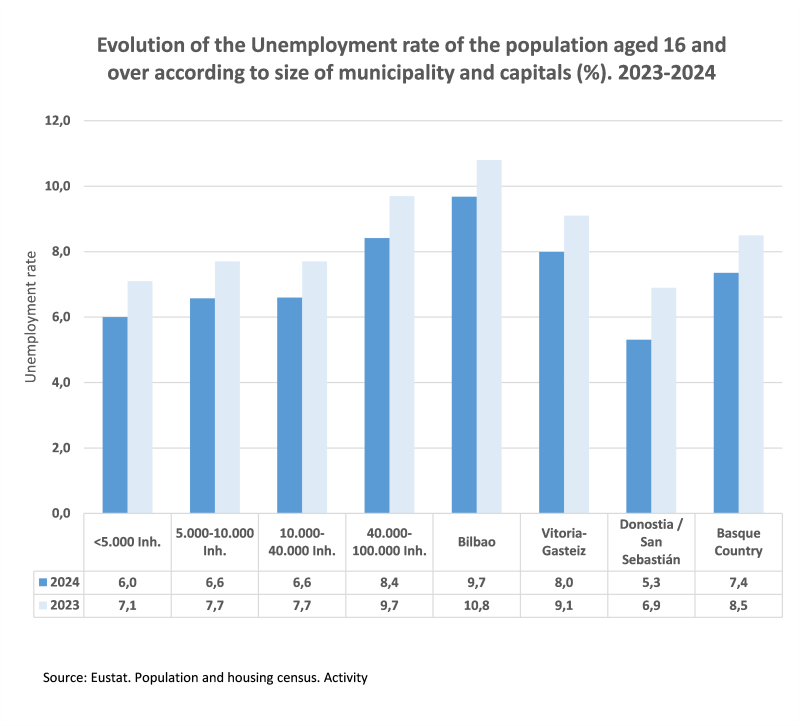
With regard to the provincial capitals, the lowest unemployment rate is found in the capital of Guipúzcoa, San Sebastián, whose figure of 5.3% is 1.6 percentage points lower than the previous year. This figure is significantly lower than those recorded in Vitoria-Gasteiz (8%) and especially Bilbao (9.7%), where the unemployment rate has fallen by 1.1 percentage points in both cities.
Outside of the capitals, the unemployment rate increases as the municipalities grow in size. In the smallest municipalities, the unemployment rate is 6%; in other words, 1.4 percentage points lower than the average for the Basque Country as a whole (7.4%). The same pattern is followed by municipalities with 5,000-10,000 inhabitants and those with 10,000-40,000 inhabitants, where the rate is 6.6% (i.e. 0.8 points below the average). For their part, municipalities with 40,000-100,000 inhabitants have an unemployment rate of 8.4%; one percentage point above the average.
A below-average unemployment rate is recorded in 195 municipalities, i.e. 77.4% of the total. At the extremes, 17 municipalities have an unemployment rate below 3%. They include Kripan, Garai, Abaltzisketa, Ajangiz, Gabiria, Mutiloa, Ereño, Lagrán, Albiztur and Hernialde, all of which have smaller populations (up to 5,000 residents). At the other end of the scale, there are five municipalities whose unemployment rate exceeds 11%: Lanestosa, Sestao, Balmaseda, Alonsotegi and Santurtzi (ranked in descending order by rate). Their populations are in different size categories.
In 181 municipalities, the employment rate is above the average of 52.4%, while in 3 it is below 45%
The employment rate for residents aged 16 and over in the Basque Country (in other words, the number of people in employment as a percentage of the total population over the age of 15) is 52.4% as of 1 January 2024. This figure represents a 0.2% increase over the previous year. At the regional level, 14 of the 20 regions have recorded an increase in the employment rate compared to 2023; in two of the regions there is no change; and in four of the regions the employment rate has fallen by 0.1-0.6 percentage points.
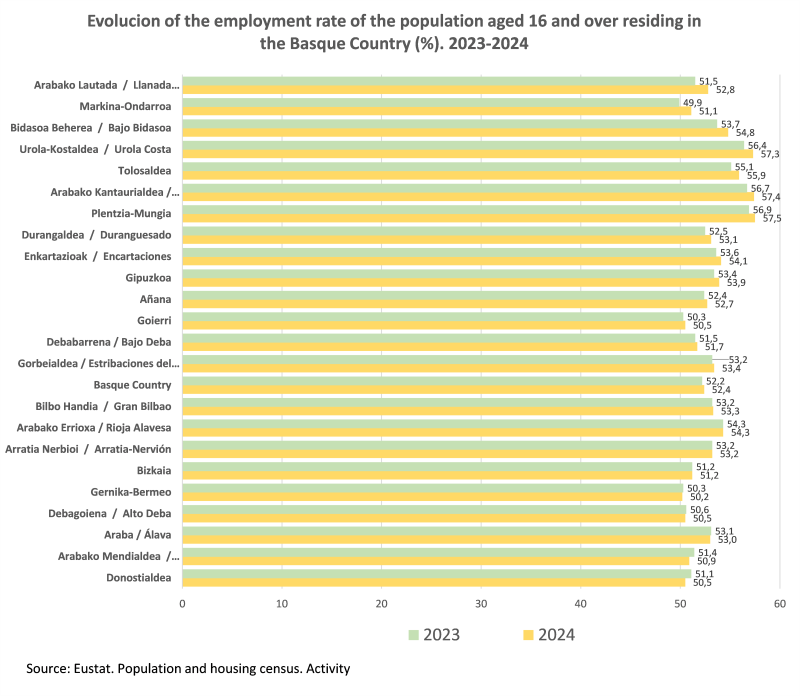
The region of Plentzia-Mungia tops the ranking with the highest employment rate, which stands at 57.5%; an increase of 0.6 percentage points in relation to 2023. It is followed by Estribaciones del Gorbea with a rate of 57.4%, representing an increase of 0.7 percentage points compared to the previous year. In third place is Urola Kosta with 57.3%; an increase of 0.9 percentage points.
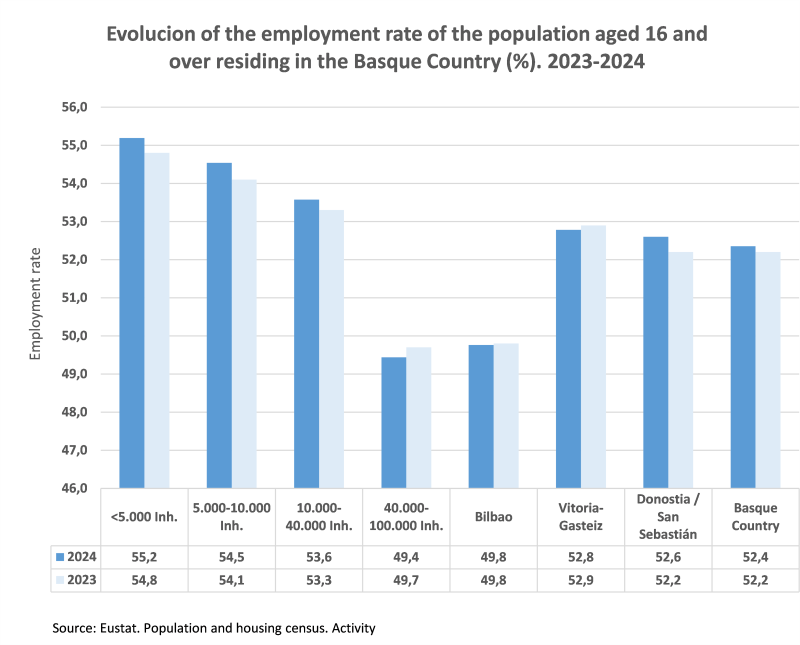
In terms of population size, municipalities with fewer than 5,000 inhabitants have a relatively high average employment rate of 55.2%, some 2.8 percentage points above the average for the Basque Country as a whole. This size category includes municipalities where the rates are significantly higher, such as Baliarrain (74.1%), Orendain (69.9%) and Irura (67.5%). At the other extreme are the municipalities of Lanestosa (41.4%), Elantxobe (44.2%) and Trucios-Trutzioz (44.9%).
In the next size category (municipalities with 5,000-10,000 inhabitants), the average employment rate is 54.5%; 2.2 percentage points above the Basque Country average. The highest rates are recorded in Astigarraga (69%) and Urduliz (61.9%), while the lowest are in Balmaseda (47.4%), Ondarroa (49.2%) and Ortuella (49.9%).
For municipalities with 10,000-40,000 inhabitants, the average employment rate is 53.6%; still 1.2 percentage points above the overall average. Of particular note within this category are Etxebarri (62.3%) and Sopela (59.3%). In municipalities with 40,000-100,000 inhabitants, the average employment rate has fallen to 49.4%; nearly 3 percentage points below the average. The municipalities in this category are led by Irun, with 51.2%, followed by Barakaldo with 51%.
Lastly, with regard to the provincial capitals, Vitoria-Gasteiz has the highest employment rate (52.8%), closely followed by San Sebastián (52.6%). The figure for Bilbao is 49.8%.
Half of all people in employment work in the same province where they have their home, albeit in a different municipality
In the Basque Country, 38.6% of the employed population work in the same municipality in which they reside. This figure is significantly higher in Álava: 71.3%, or in other words, seven out of every 10 people in employment. In Gipúzkoa, the proportion is 37.2% – which is similar to the average for the Basque Country as a whole – while in Bizkaia it falls to 29.9%.
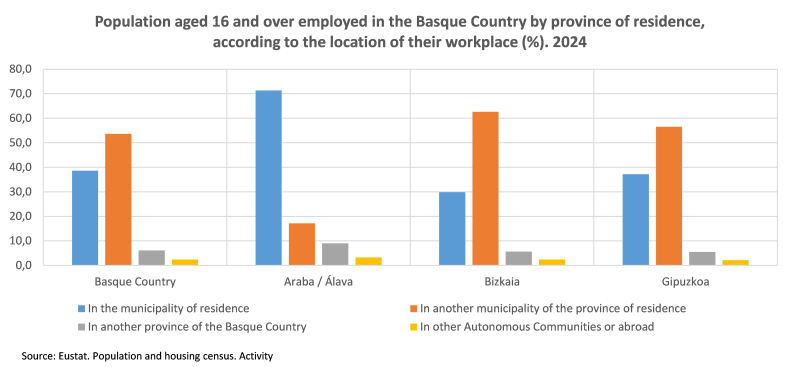
However, 53.7% of employed residents work in a different municipality to the one they live in, albeit still within the same province. This figure represents an increase of 2.4 percentage points compared to 2023. The distribution varies significantly between provinces: in Bizkaia, this figure reaches 62.6%, while in Gipúzkoa it stands at 56.5%.
In Álava, however, just 17.1% of people in employment work outside of the municipality they live in (although still within the same province).
Lastly, 6.1% of people in employment have their workplace in another province within the Basque Country, while the remaining 2.4% work in another Autonomous Region or abroad.
For further information:
Eustat - Euskal Estatistika Erakundea / Basque Statistics Institute
C/ Donostia-San Sebastián, 1 01010 Vitoria-Gasteiz
Press service: servicioprensa@eustat.es Tel: 945 01 75 62